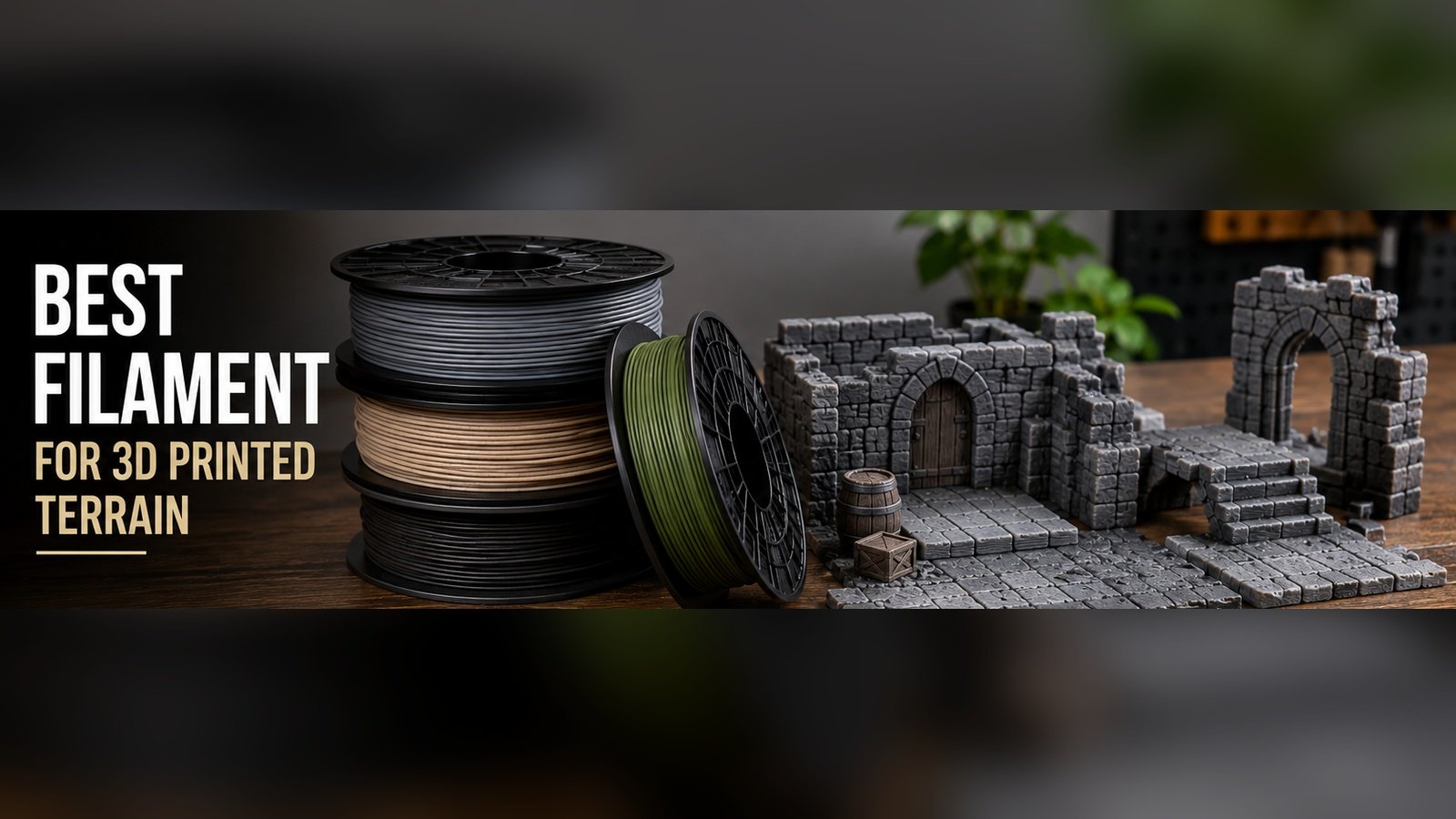
TLDR
- PLA is the best filament for most 3D printed terrain.
- Standard PLA is inexpensive, easy to print, holds detail well, and has very little warping.
- High-speed PLA can be a good choice on newer, faster printers, especially when producing large terrain sets.
- PLA+ may offer better toughness, but “PLA+” is not a standardized material. Properties vary by manufacturer.
- PETG is useful when you need more heat resistance or toughness, but it tends to string more and can produce less crisp fine detail.
- For ordinary dungeon tiles, walls, castles, buildings, ruins, and scatter terrain, we would start with PLA.
Terrain doesn’t ask much from filament in the traditional engineering sense.
A dungeon wall doesn’t need to hold up an engine. A stone floor doesn’t need to survive outdoors for ten years. What terrain does need is good detail, reliable printing, reasonable durability, and a material cheap enough that printing an entire dungeon doesn’t become painful.
That is why PLA is usually the best filament for 3D printed terrain.
There are reasons to use PLA+, PETG, and specialty filaments. And modern high-speed printers have made filament flow characteristics more important than they once were. But if you want one material that handles the majority of tabletop terrain well, ordinary PLA remains very hard to beat.
Why PLA Works So Well for Tabletop Terrain
PLA has several characteristics that happen to line up nicely with what terrain needs.
It is relatively easy to print. It holds detail well. It experiences little warping compared with many engineering plastics. And it works for both small detailed objects and large models that occupy much of the print bed.
Those are useful traits when you’re printing terrain pieces such as:
- dungeon tiles
- stone walls
- castle sections
- towers
- buildings
- roofs
- stairs
- bridges
- ruins
- caverns
- scatter terrain
Prusa describes PLA as inexpensive, easy to print, capable of producing detailed models, and resistant to significant warping. Those advantages are almost a checklist for a good terrain material.
PLA’s main weakness is temperature resistance.
For terrain that lives in a game room, shelf, cabinet, or storage bin inside the house, that usually isn’t a serious issue. It becomes more important if you routinely leave terrain in a hot vehicle, store it in an unconditioned space, or use it somewhere exposed to substantial heat.
For ordinary indoor tabletop use, PLA is our default recommendation.
Standard PLA: The Best Starting Point
You do not need an exotic material to get excellent terrain.
Standard PLA is particularly good when the goal is to reproduce visible stone texture, wood grain, cracks, bricks, floor tiles, shingles, masonry, and architectural shapes.
It is also forgiving enough that you can focus on dialing in the printer rather than fighting the material.
That matters more than it sounds.
Terrain often involves long prints and large batches. A filament that saves a few dollars but causes inconsistent extrusion, poor bed adhesion, or repeated failures can quickly become more expensive than simply buying reliable PLA in the first place.
Consistency is more valuable than chasing the lowest spool price.
For a large modular terrain collection, we would rather have several spools of PLA that behave predictably than a shelf full of unrelated materials that all need different settings.
What About PLA+?
PLA+ can be a good terrain material, but the name is less useful than it appears.
There is no single universal PLA+ formulation. Manufacturers modify PLA in different ways and sell those blends under names such as PLA+, PLA Plus, PLA Pro, Tough PLA, and similar terms.
The additives may be intended to improve impact resistance, toughness, layer adhesion, flow, or surface finish.
That means comparing “PLA versus PLA+” is not quite like comparing PLA versus PETG.
You are really comparing standard PLA against a particular manufacturer’s modified PLA formulation.
Recent comparisons of commercial PLA+ products continue to find substantial differences between brands, which is why the technical data for the specific filament matters more than the plus symbol on the spool.
For terrain, PLA+ can make sense when you want pieces that are a little less brittle.
That could be useful for:
- narrow wall sections
- connectors
- clips
- railings
- thin architectural details
- terrain that gets transported frequently
- pieces handled heavily during games
But don’t assume PLA+ is automatically better.
If standard PLA already gives you strong, clean, reliable prints, there may be little reason to change.
High-Speed PLA Is Becoming More Relevant
Modern FDM printers can move much faster than older desktop machines.
At higher speeds, however, the printer has to melt and push filament through the hotend quickly enough to keep up. Eventually the limiting factor is not how fast the toolhead can move. It is how quickly the material can melt and flow consistently.
That is where high-speed or high-flow PLA becomes interesting.
These filaments are formulated to maintain more consistent flow at higher print speeds.
For example, eSUN describes its PLA-HS as having melt-flow and cooling properties designed for faster printing, with a published printing-speed range reaching 300 mm/s for that material.
This doesn’t mean you should immediately print every castle wall at the highest speed printed on the box.
Terrain still contains corners, fine textures, overhangs, arches, and small details that benefit from controlled speeds.
But high-speed PLA can be a good match for modern printers when you are producing a lot of terrain.
That is especially true for large:
- floors
- walls
- towers
- roofs
- buildings
- terrain bases
If your printer has a high-flow hotend and aggressive default profiles, using filament designed for that type of machine may help maintain consistent extrusion.
Standard PLA vs High-Speed PLA
The choice is fairly simple.
Use standard PLA if your printer already produces reliable terrain at the speeds you normally use.
Consider high-speed PLA if you have a modern fast printer and regularly run into volumetric-flow limits when printing large parts.
High-speed filament does not magically make tiny terrain details better. It simply gives the hotend more room to maintain flow as speeds increase.
For many hobby printers, standard PLA remains completely adequate.
For someone printing large modular terrain collections on a newer high-speed machine, high-flow PLA becomes much more useful.
PLA vs PETG for Terrain
PETG has real advantages.
It is tougher than PLA, offers better temperature resistance, has strong layer adhesion, and has relatively low warping.
Prusa specifically recommends PETG for mechanical parts and notes its durability, flexibility, water resistance, and higher temperature resistance.
Those characteristics sound great.
But PETG also comes with tradeoffs that matter for terrain.
It is more prone to stringing and oozing. Bridging and overhang behavior can be worse than PLA. Supports can also be harder to remove, and very fine details are not necessarily as crisp.
That makes the decision less about which plastic is “stronger” and more about what the terrain actually needs.
Choose PLA When:
- the terrain will normally be used indoors
- fine texture matters
- you want easy printing
- you need lots of pieces
- you want good bridges and overhangs
- you plan to paint the terrain
- heat resistance is not a major concern
Consider PETG When:
- the terrain may be stored in hot environments
- pieces need additional toughness
- the terrain will see unusually rough handling
- water resistance matters
- the model is not heavily dependent on tiny crisp features
PETG is a useful material.
It just solves problems that many tabletop terrain pieces don’t actually have.
Is PLA Durable Enough for Terrain?
Usually, yes.
Terrain is bulky compared with miniatures. A dungeon floor tile or castle wall has much more cross-sectional area than a miniature sword, spear, or wrist.
That makes ordinary PLA surprisingly durable for typical tabletop handling.
Where failures become more likely is around thin features:
- narrow railings
- tiny branches
- thin posts
- exposed connectors
- decorative spikes
- unsupported protrusions
Those parts may benefit from a tougher design, different print orientation, extra wall thickness, or a tougher filament.
But changing the entire terrain collection to another material is rarely the first fix we would make.
Good geometry matters.
A fragile railing printed in tougher plastic is still a fragile railing.
What Filament Color Should You Use?
If you are painting the terrain, filament color isn’t especially important.
Gray is convenient because surface detail is easy to see during inspection. Black can work well for dark stone and may make missed areas less noticeable during painting. White makes it easy to see defects but can be visually harsh before primer.
The biggest practical advantage is consistency.
If you print an entire terrain family from similar filament, it is easier to inspect the pieces together and easier to maintain repeatable printer settings.
And if a piece remains unpainted for a while, neutral gray terrain is not exactly difficult to live with.
What About Matte PLA?
Matte filament is popular for display prints because its surface can reduce the shiny plastic appearance associated with some PLA.
That can make unpainted terrain look better straight from the printer.
But once you prime and paint the model, much of that advantage disappears.
For painted terrain, print quality, consistency, price, and flow characteristics matter more than whether the raw filament has a matte finish.
If you like matte PLA and it prints reliably on your machine, use it.
Just don’t feel like terrain requires it.
Specialty Filaments Can Be Fun, but They Aren’t Necessary
There are PLA blends designed to look like:
- wood
- marble
- stone
- metal
- glitter
- glow-in-the-dark materials
Some can produce interesting effects.
A marble filament may look surprisingly convincing on a statue. Wood-filled filament can give timber pieces a distinctive finish. Glow material can be fun for crystals or magical terrain.
But specialty filament creates additional variables.
Some filled and glow-in-the-dark materials are abrasive and may require a hardened nozzle. Filled filaments can also be more prone to clogging, particularly with smaller nozzles.
For an entire modular dungeon, standard filament is usually simpler.
Use specialty materials because the material itself contributes something to the finished piece, not because terrain requires fancy filament.
Filament Matters, but Terrain Design Matters More
It’s easy to spend a lot of time comparing filament specifications while ignoring the STL.
The model itself has a much greater effect on how terrain prints.
FDM-friendly terrain should use details large enough to survive the nozzle size and layer height being used.
It should also account for:
- overhang angles
- bridging
- wall thickness
- relief depth
- connector tolerances
- print orientation
- bed contact
- support requirements
A carefully designed wall printed in ordinary PLA will generally outperform a poorly designed wall printed in an expensive specialty material.
Filament cannot fix geometry the printer was never going to reproduce properly.
Our Practical Filament Ranking for Terrain
| Filament | Terrain Use | Our Take |
|---|---|---|
| Standard PLA | Almost everything | Best overall choice |
| High-Speed PLA | Large batches on fast printers | Excellent when speed matters |
| PLA+ | Heavily handled terrain and connectors | Useful, but compare specific brands |
| PETG | Tough or heat-exposed terrain | Good specialty choice |
| Matte PLA | Unpainted/display terrain | Mostly an appearance preference |
| Wood/Stone PLA | Specialty pieces | Fun for specific effects |
| ABS/ASA | Specialized applications | Usually unnecessary for indoor terrain |
| TPU | Flexible parts | Poor match for ordinary structures |
What We Would Actually Buy
If we were starting a terrain collection from scratch, we would keep it simple.
Start with a reliable PLA that has a good profile for your printer.
Print several different types of terrain with it:
- a floor
- a textured wall
- an arch
- a connector
- a larger building section
If everything looks good, keep using it.
Once you know what limitation you are trying to solve, then experiment.
Move to high-speed PLA because you need more flow.
Try PLA+ because a particular piece needs more toughness.
Use PETG because heat resistance actually matters.
That is a much better approach than switching materials because one spool sounds more advanced than another.
FAQs
What is the best filament for D&D terrain?
PLA is the best starting choice for most D&D terrain. It prints easily, holds stone and wood details well, experiences little warping, and is inexpensive enough for large modular sets.
Is PLA or PLA+ better for terrain?
Both work well. PLA is usually sufficient for ordinary terrain. PLA+ may offer greater toughness, but formulations vary significantly between manufacturers, so compare the actual filament specifications rather than relying on the PLA+ label.
Should I use high-speed PLA for terrain?
If your printer is designed for fast printing, high-speed or high-flow PLA can make sense. It can help the hotend maintain consistent extrusion during faster, larger terrain prints.
Is PETG better than PLA for dungeon terrain?
Not usually. PETG is tougher and more temperature resistant, but PLA generally offers simpler printing, cleaner bridging, less stringing, and excellent detail. PETG makes more sense when its durability or heat resistance solves a specific problem.
Can PLA terrain warp in a hot car?
PLA has relatively low heat resistance, so prolonged exposure to high temperatures can deform printed parts. If hot-car storage is unavoidable, a more temperature-resistant material may be worth considering.
Does filament brand matter for terrain?
Consistency matters more than the name on the spool. A filament that maintains predictable diameter, flow, temperature behavior, and color from spool to spool makes printing large terrain collections much easier.
The Bottom Line
For most people, the best filament for 3D printed terrain is PLA.
It is inexpensive, reliable, detailed, easy to print, and well suited to the large architectural pieces that make up most tabletop environments.
And there is no need to complicate the choice before you encounter an actual problem.
Use reliable PLA first.
Choose high-speed PLA when your printer needs additional flow. Try PLA+ when you want more toughness. Move to PETG when heat resistance or durability justifies the printing tradeoffs.
Terrain can become complicated quickly.
The filament doesn’t have to.
References
- Prusa Knowledge Base, PLA material guide.
- Prusa Knowledge Base, PETG material guide.
- Prusa Knowledge Base, Filament Material Guide.
- eSUN, PLA-HS high-speed filament specifications.
- Filabase, comparison of PLA+, PLA Pro, and PLA Max formulations.
- Iain Lovecraft, FDM terrain printing and filament guidance.