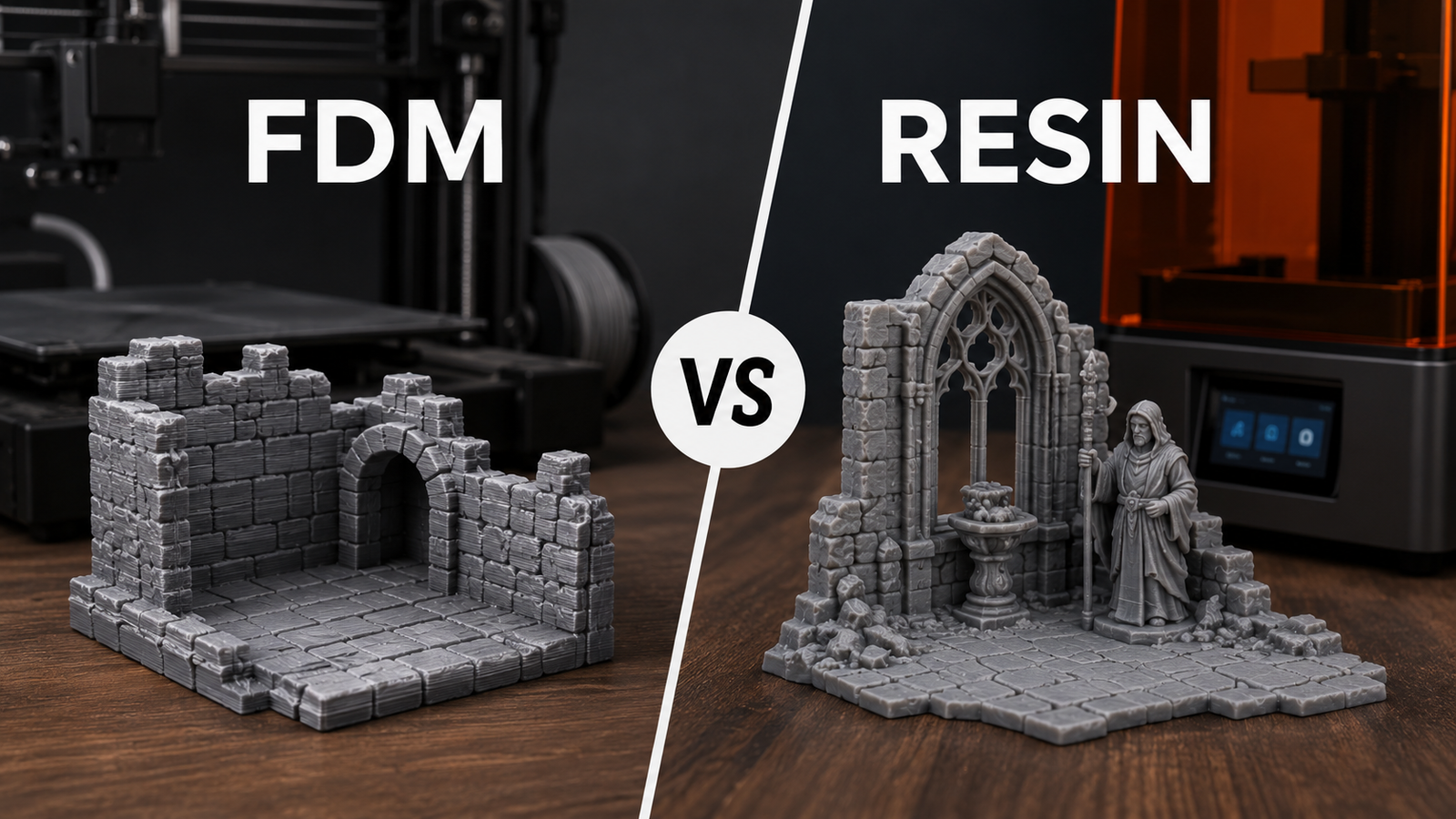
TLDR
- FDM is the better choice for most 3D printed terrain, especially dungeon tiles, walls, buildings, towers, and large modular sets.
- Resin produces finer detail and smoother surfaces, which makes it useful for statues, ornate decorations, small scatter pieces, and miniature-like terrain.
- FDM is generally easier and less expensive to run when you need a lot of terrain.
- Resin requires washing and post-curing, while many FDM terrain prints can go almost directly from the print bed to primer.
- If you are buying one printer primarily for tabletop terrain, we would usually choose FDM.
- If you own both printer types, using FDM for the structure and resin for small detail pieces gives you a lot of flexibility.
A dragon miniature and a twelve-inch castle wall may both be STL files, but they ask very different things from a 3D printer.
That is the most important point in the FDM vs resin for 3D printed terrain debate. Resin has a deserved reputation for incredible detail. But terrain is usually much larger than a miniature, and the details that make a dungeon wall look convincing are not the same details that make a character’s face look convincing.
For most tabletop terrain, FDM makes more practical sense. Resin still has a place, especially as terrain gets smaller or more decorative.
Here is where each printing method works best.
FDM and Resin Printing Work Differently
FDM, or fused deposition modeling, builds a model by melting filament and laying it down one line at a time. PLA is one of the most common materials for tabletop terrain.
Resin printers use light to cure liquid photopolymer resin one layer at a time. Consumer resin printers commonly use MSLA technology, while SLA is another form of resin printing.
Both can make excellent terrain. Their strengths are simply different.
A typical FDM printer uses a nozzle around 0.4 mm in diameter and might print terrain at layer heights around 0.12 to 0.24 mm. Resin printers can reproduce much smaller features and use substantially thinner layers.
That sounds like an automatic win for resin.
It isn’t.
Resin Wins on Fine Detail
If pure detail is the goal, resin is the stronger technology.
Tiny skulls, carved lettering, faces, jewelry, chains, decorative trim, cloth texture, and other miniature-scale details are easier to reproduce cleanly in resin. Smooth curved surfaces can also show much less obvious stepping.
FDM has physical limits created by the nozzle diameter, extrusion width, and layer height. Prusa notes that layer height primarily controls vertical resolution, while nozzle diameter has a major effect on detail in the horizontal plane.
But there is a catch: most tabletop terrain doesn’t need miniature-level resolution.
A stone block can be fairly large. So can mortar lines, wooden planks, floor cracks, roof shingles, bricks, beams, and dungeon flagstones. These features are large enough to reproduce well on a properly tuned FDM printer.
Once the model is primed, painted, washed, and drybrushed, the difference becomes even less important at normal tabletop distance.
Resin’s extra resolution is real. You just don’t always need it.
Large Terrain Favors FDM
Terrain has a habit of getting big.
A few dungeon tiles can turn into an entire room. A wall becomes a gatehouse. The gatehouse needs a tower. Then somebody decides the tower needs a second floor.
This is where FDM starts to make a lot more sense.
FDM printers commonly offer generous build areas that are well suited to floors, long walls, roofs, bridges, towers, and complete building sections. Large-format FDM printers take that advantage even further.
A large piece that fits on an FDM build plate may have to be divided into several parts for a smaller resin printer.
That doesn’t make resin unusable for large terrain. You can split models and assemble them afterward. But every split adds another seam, another alignment point, and another step between downloading the file and putting the finished piece on the table.
For modular terrain that already consists of multiple pieces, keeping the individual pieces easy to print matters.
FDM Is Usually More Practical for an Entire Table
One terrain piece does not use much material.
Fifty terrain pieces do.
For a full dungeon or battlefield, you may need:
- floor tiles
- straight walls
- corners
- doors
- stairs
- columns
- upper floors
- roofs
- scatter terrain
- towers
- bridges
- ruined pieces
- alternate room configurations
FDM can use hollow internal areas and sparse infill where appropriate, so a large model does not need to be a solid block of plastic.
Filament is also straightforward to handle. You load a spool, print the model, and store the remaining filament for later.
Resin has additional consumables and workflow requirements. Depending on the printer and material, these can include wash solution or isopropyl alcohol, gloves, resin vat films, filters, cleaning materials, and curing equipment.
That difference becomes more noticeable as the terrain collection grows.
Post-Processing Is a Major Difference
This may matter more than resolution for some people.
A well-designed FDM terrain file can be surprisingly low maintenance after printing. If the model prints without supports, you may only need to remove it from the build plate, clean up an occasional string or rough edge, and prime it.
Resin printing has a required post-processing workflow.
Excess uncured resin needs to be removed from the finished part. Formlabs describes washing resin prints in a suitable solvent and then post-curing them with light and, depending on the material, heat. Formlabs also recommends gloves when handling surfaces contaminated with liquid resin or solvent.
None of this makes resin printing unreasonable. Plenty of hobbyists use resin printers every day.
But there is more equipment, more cleanup, and more handling involved.
If you plan to print dozens or hundreds of modular terrain pieces over time, those extra steps matter.
FDM Terrain Can Be More Forgiving at the Table
Terrain is handled.
Players move it. Dungeon Masters rearrange it. Buildings get stacked in storage bins. Walls are knocked over while somebody reaches across the table for a miniature.
That changes how we think about print quality.
The sharpest possible detail isn’t always the most important feature. A terrain piece also needs to survive repeated setup, teardown, storage, and play.
PLA FDM terrain is generally well suited to that type of use. Thin decorative details can still break, but walls, floors, buildings, and other substantial pieces can be quite durable when designed and printed properly.
Standard hobby resins can be more brittle, although tougher resin formulations are available.
If you print terrain in resin, material choice becomes especially important for protruding details, thin railings, narrow branches, and other areas likely to get bumped.
What About Supports?
Both technologies sometimes need supports, but the workflow is different.
Resin printing commonly uses supports to hold the model at an angle above the build plate. Orientation and support placement can have a major effect on both print success and the finished surface.
FDM supports are used when geometry cannot otherwise be printed reliably over open air.
But terrain can often be designed specifically around FDM limitations.
A good FDM terrain model may use:
- printable arch angles
- bridges that stay within reasonable spans
- roofs oriented for clean printing
- hidden flat surfaces
- separate doors or inserts
- parts divided along natural architectural seams
Support-free terrain is valuable because supports use extra material, increase print time, and can leave marks behind.
It also makes printing a large terrain collection much less tedious.
Which Is Faster for Terrain?
There isn’t a universal winner.
FDM print time depends heavily on the amount of plastic the machine must extrude. Larger objects usually take longer.
MSLA resin printers expose an entire layer at once. This means adding several small objects across the same build plate may add relatively little time compared with printing them one after another on an FDM machine.
That makes resin particularly good for batches of small pieces.
Need twenty tiny skull piles, candles, bottles, or highly detailed statues? Resin may be a great fit.
Need one large tavern wall? FDM is likely the easier choice.
So instead of asking which technology is faster, ask what you are printing.
A Practical FDM vs Resin Terrain Guide
| Terrain Type | Usually Better Choice | Why |
|---|---|---|
| Dungeon floor tiles | FDM | Large, simple, inexpensive to produce in quantity |
| Straight dungeon walls | FDM | Strong and easy to batch |
| Buildings | FDM | Large build volume matters |
| Towers | FDM | Large structural parts favor filament |
| Bridges | FDM | Good durability and size capacity |
| Roofs | FDM | Large surface area |
| Crates and barrels | Either | Depends on desired detail |
| Statues | Resin | Fine sculpted detail |
| Tiny furniture | Resin | Small details benefit from higher resolution |
| Decorative wall inserts | Resin | Good use of resin as an accent |
| Doors | Either | Simple doors print well in FDM; ornate ones may favor resin |
| Miniatures | Resin | Fine character detail |
| Large rocks and cavern terrain | FDM | Organic texture does not usually require resin resolution |
This isn’t a rulebook. It is a practical starting point.
The Best Setup May Be Both
You don’t actually have to choose one technology forever.
FDM and resin complement each other extremely well.
You might print a castle in FDM, then use resin for:
- gargoyles
- statues
- torches
- weapon racks
- decorative shields
- skulls
- furniture
- tiny architectural details
The large parts remain inexpensive and durable, while resin is used where its extra resolution actually changes the result.
This hybrid approach avoids spending resin on a giant stone wall that doesn’t need it.
Which Printer Should You Buy First for Terrain?
If tabletop terrain is your main goal, start with FDM.
It is the more flexible option for printing the large structural pieces that consume most of the space on a gaming table.
A 0.4 mm nozzle can produce a surprising amount of useful terrain detail while still keeping print times reasonable. You can also experiment later with smaller layer heights or different nozzle sizes when a particular model needs them.
If your main goal is miniatures and you only occasionally print terrain, resin makes more sense as your first printer.
Think about what will occupy most of your build plate, not which technology wins a resolution specification.
FAQs
Is resin better quality than FDM?
Resin generally produces finer detail and smoother small features. But that does not automatically make it better for terrain. Large stone walls, dungeon floors, buildings, and similar pieces can look excellent in FDM.
Can you print D&D terrain with a resin printer?
Yes. Resin can make excellent D&D terrain, particularly small and detailed pieces. The disadvantages become more noticeable as the models get larger and you need more of them.
Is FDM detailed enough for tabletop terrain?
For most terrain, yes. Features such as stone blocks, brickwork, wooden planks, roof tiles, cracks, and masonry are large enough to reproduce well with a 0.4 mm nozzle when the model is designed for FDM printing.
Should I use PLA for FDM terrain?
PLA is a strong starting choice for most tabletop terrain. It is widely available, easy to print, holds detail well, and does not require the higher printing temperatures associated with some other filament types.
Is resin better for miniatures?
Usually, yes. Miniatures contain facial features, equipment, clothing, hair, weapons, and other small details that benefit much more from resin’s resolution.
Do I need a resin printer if I already have an FDM printer?
Not necessarily. An FDM printer can handle a huge range of terrain. A resin printer becomes useful if you also want to print detailed miniatures, tiny scatter pieces, statues, or decorative components that push beyond normal FDM resolution.
The Bottom Line
For most 3D printed tabletop terrain, FDM is the better starting point.
It gives you the build area, durability, straightforward workflow, and material efficiency needed to turn a few STL files into an actual dungeon, castle, village, or battlefield.
Resin wins when the details become small enough that you can actually see the difference.
And that is probably the simplest rule to remember: use FDM for the terrain’s structure and resin when tiny detail is the point.
References
- Prusa Knowledge Base, “Layers and Perimeters.”
- Prusa Research, “Everything About Nozzles With a Different Diameter.”
- Formlabs, “Best Practices for Washing Prints.”
- Formlabs, “Wash and Cure.”