TLDR
- The material cost of 3D printed terrain is often only a few dollars per piece.
- With PLA at $20 per kilogram, every 100 grams of filament costs about $2.
- Electricity is usually a much smaller expense than filament. Using a 120-watt average draw and the May 2026 U.S. residential average of 18.44 cents per kWh, running a printer for 10 hours costs about $0.22 in electricity.
- A 500-gram building printed with $20/kg PLA would use about $10 in filament before waste, failed prints, or machine wear.
- An entire modular dungeon may consume several kilograms of filament, so total cost depends much more on how much terrain you print than on the cost of any individual tile.
- If you want the true cost rather than the immediate out-of-pocket cost, also account for failed prints, replacement parts, and printer depreciation.
One of the pleasant surprises of owning a 3D printer is discovering how little plastic is actually inside many large terrain pieces.
A castle wall can look substantial while still being mostly hollow inside. A dungeon tile may use only a small amount of PLA. And even a large building doesn’t necessarily require anything close to a full spool.
So how much does it cost to 3D print tabletop terrain?
For most home FDM printing, filament is the largest direct expense. Electricity is usually relatively small. Printer wear and failed prints matter if you want a more complete cost calculation.
The easiest way to understand the cost is to break it down piece by piece.
Start With the Cost of Filament
This is the number that matters most for most hobby terrain.
A standard filament spool commonly contains 1 kilogram, or 1,000 grams, of material.
If that spool costs $20:
$20 ÷ 1,000 grams = $0.02 per gram
From there, the math is easy.
| Filament Used | Cost at $20/kg |
|---|---|
| 25 g | $0.50 |
| 50 g | $1.00 |
| 100 g | $2.00 |
| 250 g | $5.00 |
| 500 g | $10.00 |
| 750 g | $15.00 |
| 1,000 g | $20.00 |
Your slicer normally tells you how many grams of filament a model is expected to use before you start printing.
That makes the slicer one of the best cost-estimation tools you already have.
You do not need to guess based on the physical size of the model.
A Simple Terrain Cost Formula
For the basic material cost:
Filament cost = model weight in grams ÷ 1,000 × spool price
Suppose a dungeon room requires 320 grams of PLA and your spool costs $20.
320 ÷ 1,000 × $20 = $6.40
That is the basic material cost.
If you buy filament for $25/kg instead, the same room costs:
320 ÷ 1,000 × $25 = $8.00
This is why large terrain collections make filament pricing more important than individual models do.
Saving $3 on a spool isn’t meaningful for one small wall.
It becomes more noticeable when a project consumes ten spools.
How Much Does Electricity Add?
Usually less than people expect.
The U.S. Energy Information Administration reported an average residential electricity price of 18.44 cents per kilowatt-hour in May 2026.
Actual rates vary substantially by location, so use your electric bill if you want a precise number.
The calculation is:
Printer watts ÷ 1,000 × printing hours × electricity rate
Suppose your printer averages 120 watts during a print.
Over 10 hours:
120 ÷ 1,000 × 10 = 1.2 kWh
At $0.1844 per kWh:
1.2 × $0.1844 = about $0.22
So a ten-hour terrain print might use several dollars of filament while consuming only a few dimes in electricity.
That is why electricity usually isn’t the main thing to optimize when estimating hobby terrain costs.
Example Costs for Different Terrain Pieces
Every STL is different, so there is no reliable universal cost for “a wall” or “a building.”
But we can use example weights to see the scale of the expense.
The following examples assume:
- PLA: $20/kg
- electricity: $0.1844/kWh
- average printer consumption: 120 watts
| Example Print | Filament | Print Time | Material | Electricity | Direct Cost |
|---|---|---|---|---|---|
| Small scatter piece | 25 g | 1.5 hr | $0.50 | $0.03 | $0.53 |
| Floor or small wall | 50 g | 2.5 hr | $1.00 | $0.06 | $1.06 |
| Larger wall section | 100 g | 5 hr | $2.00 | $0.11 | $2.11 |
| Room or structure | 250 g | 12 hr | $5.00 | $0.27 | $5.27 |
| Large building | 500 g | 25 hr | $10.00 | $0.55 | $10.55 |
| Very large structure | 1 kg | 50 hr | $20.00 | $1.11 | $21.11 |
These are examples, not expected weights for every terrain file.
The important part is the relationship between material and power.
Even on long prints, filament tends to dominate the direct cost.
What Does an Entire Dungeon Cost?
This is where 3D printing gets interesting.
Individual pieces can feel almost free, but terrain collections contain a lot of individual pieces.
Imagine a modular dungeon that consumes:
- 1,200 g of floor tiles
- 900 g of walls
- 350 g of corners
- 300 g of doors and specialty walls
- 250 g of stairs, pillars, and accessories
Total filament:
3,000 g, or 3 kg
At $20/kg, the material cost is:
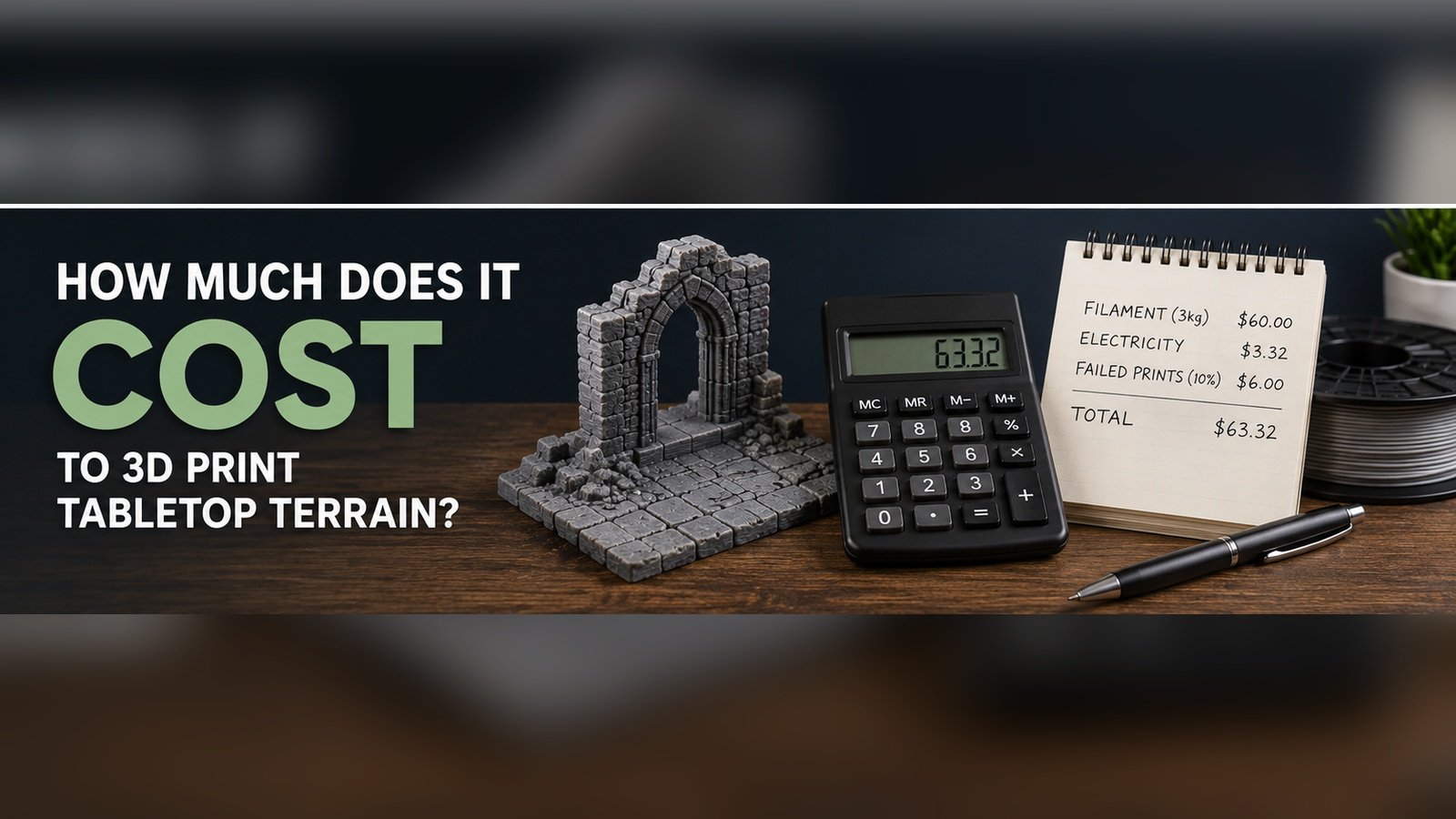
$60
If the whole collection required 150 printer-hours on a machine averaging 120 watts:
0.12 kW × 150 hours = 18 kWh
At $0.1844/kWh:
about $3.32 in electricity
The approximate direct printing cost would therefore be:
$63.32
That is before primer, paint, failed prints, machine wear, or your own time.
But you would also have several kilograms of physical terrain at the end of the process.
Infill Can Change the Cost
Terrain does not normally need to be solid.
A large wall or building can often use relatively low infill because the outside walls provide much of the structure.
Reducing infill can lower:
- filament consumption
- print time
- model weight
But there is a limit.
Extremely low infill can leave large top surfaces without enough support underneath them. It can also make certain structural areas weaker.
And on some terrain models, walls and surface shells consume far more material than the infill does anyway.
The best approach is not simply to choose the lowest possible percentage.
Slice the model at several reasonable settings and compare the estimated weight and time.
The slicer will tell you whether changing from 15% infill to 10% actually saves enough material to matter.
Sometimes the difference is surprisingly small.
Wall Count Matters Too
Perimeters, sometimes called walls or shells, affect terrain cost as well.
Adding more walls can improve durability, but it also adds plastic across every vertical surface.
That can matter a lot on architectural terrain.
A hollow building with thick walls may use substantial filament even with very little infill.
This is one reason material estimates should come from the sliced file rather than a generic cost chart.
Two buildings with the same exterior dimensions can use very different amounts of filament.
Layer Height Affects Time More Than Material
Reducing your layer height can dramatically increase print time because the printer has to create more layers.
But the material increase is often much smaller.
A 100 mm-tall wall printed at 0.20 mm requires about 500 layers.
At 0.10 mm, it requires about 1,000.
The object hasn’t become twice as large, so it doesn’t suddenly need twice as much filament.
It does require the printer to perform substantially more movements.
That means finer layer heights primarily increase machine time and electricity rather than doubling raw material cost.
For terrain, this is another reason not to automatically use the finest setting available.
Supports Are Literally Material You Throw Away
Support material should be included in your cost estimate.
Your slicer normally includes supports in its filament estimate, which makes the calculation easy.
But supports have another cost: cleanup.
A support-heavy terrain model may require you to:
- print additional plastic
- wait longer
- remove support structures
- clean contact surfaces
- dispose of the waste
For one display piece, that may be fine.
For a modular dungeon containing dozens of pieces, support-heavy designs create a lot of unnecessary work.
Terrain designed to print support-free or with minimal support can save both material and time across an entire collection.
Failed Prints Belong in the Budget
Sooner or later, something will fail.
A corner lifts.
Filament runs out.
A nozzle clogs.
A support breaks.
The build plate wasn’t clean.
The printer decides that hour 17 of an 18-hour print is the ideal moment to develop a personality.
The material used before that failure is still gone.
If you are casually printing terrain at home, you probably don’t need to assign an exact accounting value to every failure.
But if you’re comparing costs seriously, include a waste allowance.
Cost calculators commonly add a percentage for failures and waste rather than pretending every gram purchased becomes a successful print.
For example, adding a 10% material allowance to a $60 dungeon budget would increase the planned filament cost to roughly $66.
That leaves room for failed pieces, purge material, test prints, and leftovers that are difficult to use completely.
The Printer Itself Also Costs Money
There are two ways to look at printer cost.
Hobby Cost
If you already own the printer and would have bought it anyway, you may not care about depreciation.
In that case, your practical out-of-pocket terrain cost is mostly:
filament + electricity + consumables
That is a perfectly reasonable way for a hobbyist to think about the expense.
True Production Cost
If you are trying to determine the real cost of producing terrain, the printer should be included.
A simple formula is:
Printer purchase price ÷ expected printing hours = machine cost per hour
Suppose a $500 printer provides 5,000 productive printing hours before you consider its purchase cost fully absorbed.
$500 ÷ 5,000 = $0.10 per hour
A 25-hour building therefore carries another $2.50 in machine cost.
That doesn’t mean the printer literally loses $2.50 of value every time you print a building.
It is simply a useful accounting method for spreading equipment expense across the work it performs.
Current print-cost calculators commonly separate material, electricity, and machine depreciation for exactly this reason.
Don’t Forget Maintenance
Printers have wear items.
Over time you may replace:
- nozzles
- build surfaces
- PTFE tubing
- belts
- bearings
- fans
- hotend components
- extruder parts
Individual maintenance items may be inexpensive, but they are not zero.
Again, most hobbyists do not need to calculate the fraction of a nozzle consumed by every dungeon wall.
If you are selling prints or comparing true production costs, maintenance should be included in your machine-hour rate or overhead.
What About Your Time?
This is the biggest difference between printing terrain for yourself and selling it.
For personal hobby use, you probably don’t charge yourself for:
- downloading files
- slicing
- loading filament
- removing prints
- clearing supports
- troubleshooting
- assembling parts
If you enjoy the process, much of that is simply part of the hobby.
For commercial printing, labor is real.
A $4 material cost does not mean a piece should sell for $4.
Commercial pricing also has to account for labor, equipment, failures, overhead, packaging, licensing, fulfillment, and profit.
That is a different question from “How much plastic and electricity does it take to print this?”
Keeping those two questions separate prevents a lot of confusion.
3D Printing Terrain vs Buying Finished Terrain
Printing your own terrain can be inexpensive on a material basis.
But buying finished terrain provides something home printing does not: somebody else already handled the production.
When comparing the two, consider more than plastic cost.
Home printing may require:
- a printer
- filament
- setup
- slicing
- failed-print troubleshooting
- assembly
- cleanup
- storage of printing supplies
Finished terrain shifts most of that work to the manufacturer.
STL files sit somewhere in between.
You are paying for the design, but you handle production yourself. That can be especially attractive when a file is modular and you expect to print it many times for personal use.
The more useful question isn’t simply, “Which one is cheaper?”
It is, “Which parts of the process do I want to do myself?”
How to Estimate a Terrain Project Before Printing
You can get a surprisingly accurate estimate before using a single gram of filament.
- Import all required terrain files into your slicer.
- Apply the settings you actually intend to use.
- Slice the models.
- Record the total filament weight.
- Multiply that weight by your filament cost per gram.
- Record the total print time.
- Calculate electricity using your printer’s measured or estimated average wattage.
- Add a small allowance for failed prints and waste.
- Add machine wear if you want a true production cost.
For a personal terrain project, steps 1 through 7 are usually enough.
FAQs
How much does 100 grams of PLA cost?
On a $20/kg spool, 100 grams costs $2. At $25/kg, it costs $2.50.
Does a 3D printer use a lot of electricity?
Not compared with the cost of filament in most terrain projects. For example, a printer averaging 120 watts for ten hours uses 1.2 kWh. At the May 2026 U.S. residential average of 18.44 cents per kWh, that is about $0.22.
Is it cheaper to print your own D&D terrain?
The direct material cost can be quite low, especially if you already own the printer. But total value depends on the price of the STL files, your printer investment, failed prints, maintenance, and how much you value your time.
How much terrain can you print with one spool of PLA?
There is no reliable universal count because terrain models vary tremendously. The best method is to slice the files and look at the estimated filament weight. A 1 kg spool provides about 1,000 grams of usable filament before waste.
Does lower infill make terrain much cheaper?
Sometimes, but not always. Architectural models often use a significant amount of material in their walls and top surfaces. Slice the same model at several infill percentages to see whether the savings are meaningful.
Should I include failed prints when calculating cost?
Yes, if you want a realistic project or production budget. A small waste allowance accounts for failed prints, test pieces, purge material, and filament that never becomes part of a finished model.
The Bottom Line
3D printed tabletop terrain can be surprisingly inexpensive to produce.
At $20 per kilogram, 100 grams of PLA costs about $2. Even long prints often add only a modest amount of electricity compared with the material itself.
The bigger cost comes from scale.
One wall is cheap.
An entire dungeon contains a lot of walls.
So before starting a large terrain project, slice the complete set and look at the total filament estimate. That one number will tell you far more than guessing based on how large the models look.
And if you want a true cost rather than just an out-of-pocket hobby cost, add failed prints, machine wear, maintenance, and time.
That gives you a realistic picture of what your dungeon, castle, village, or battlefield actually costs to build.
References
- U.S. Energy Information Administration, May 2026 residential electricity prices.
- SharpDev.Tools, filament and electricity cost methodology.
- PrintNexus, 3D print cost methodology including material, electricity, machine time, and labor.
- Calculator Collection, material, electricity, and printer depreciation calculation.
- CalcCorp, 2026 3D printing cost examples and failure allowances.