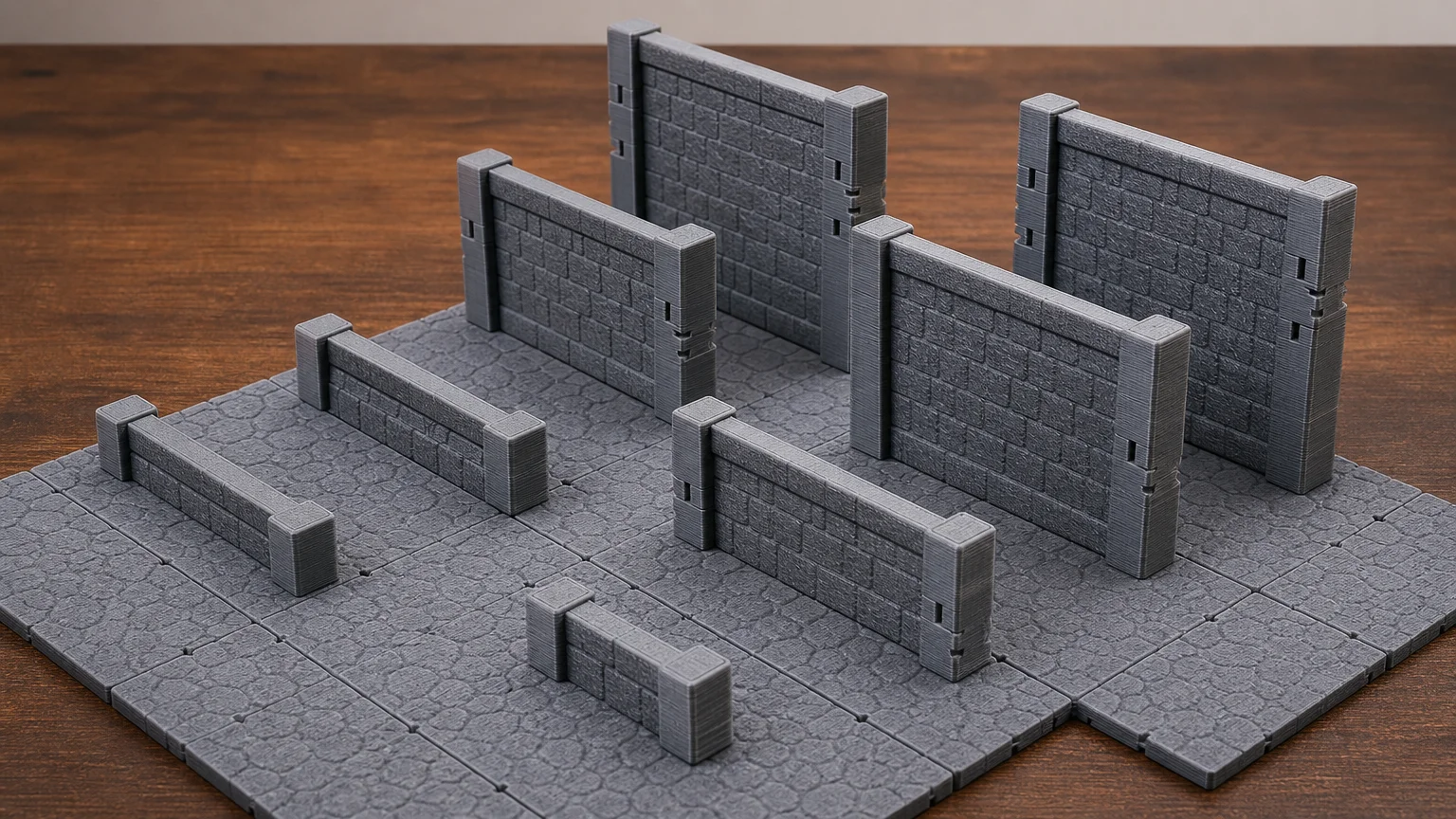
TLDR: There’s no single best 3D printed dungeon wall height—most gamers use half-height walls (0.5–0.75 inches/12–19 mm) for visibility and access, but full-height walls (1.5–2.5 inches/38–63 mm) can boost immersion. Practical wall height depends on your preferred balance of playability and realism, the scale of your miniatures, and your table space.
When starting a 3D printed dungeon project, one of the first design questions is "How tall should my walls be?" It isn’t just a matter of looks; wall height shapes gameplay, visibility, and how players interact with the table. And, as many hobbyists quickly discover, there’s no universal dimension. The right 3D printed dungeon wall height is a direct result of scale, play style, and practical needs around the gaming table.
What Heights Are Common for 3D Printed Dungeon Walls?
Active terrain-building communities report a wide range of wall heights. For most games using a 1-inch grid and standard 28–32 mm miniatures, hobbyists tend to choose:
- Full-height walls: Around 1.5 to 2.5 inches (38–63 mm). These mimic architectural reality, sometimes reaching above a miniature’s head .
- Half-height walls: Typically 0.5 to 0.75 inches (12–19 mm). These usually stand around waist or chest height for a standard miniature and are preferred for gameplay .
- Low walls: Ranges as low as 0.25 inches (~0.75 cm) are used when maximizing visibility or board access is the top priority .
Though some commercial brands do specify heights, most recommendations are community-driven. Saucermen Studios, for example, developed their low wall line explicitly to improve line of sight for 28–32 mm games . DungeonSticks by johnDangle are intentionally less than full miniature height for the same reason .
Visibility, Line of Sight, and Access
Why do so many hobbyists choose shorter walls? The answer comes down to playability. Tall walls look immersive but can block your view of the game board, hide action from across the table, and make it hard to move miniatures or reach into rooms. Half-height or low walls let everyone see and maneuver figures easily, reducing frustration at busy tables.
Many games also use line of sight (LoS) rules, and some published guides assign a numerical 'height' value to walls to help clarify who can see or shoot over them—sometimes reporting a physical 2-inch wall as "height 3" in rules terms Basic Line of Sight Guide. The physical wall height, then, becomes both an aesthetic and a practical choice.
Immersion vs. Playability: Full-Height or Half-Height Walls?
It can be tempting to print walls as high as real dungeon architecture—tall enough for a full-sized miniature door. In practice, full-height walls (1.5–2.5 inches) offer impressive diorama-like scenes, especially if you run games with multiple levels or vertical movement. But they can also become unwieldy and block sightlines, especially with larger tables or group play .
Half-height walls, meanwhile, strike a balance. They suggest vertical boundaries, keep hands free to move miniatures, and let players see room interiors clearly. Most gamers choose a modular wall that comes up to a figure’s waist or chest—enough to frame the space, but not so tall as to hide the action.
Does Miniature Scale Affect Wall Height?
Yes—wall height should scale with your miniatures and grid. For 28 mm figures on a 1-inch grid, a half-height wall of around 0.5–0.75 inches (12–19 mm) feels right. If you print larger (for 32 mm or 40 mm minis), the wall may need to be a little taller to provide the same proportional effect. Some hobbyists suggest scaling the wall’s Z (vertical) dimension up by 12% to match miniatures with differently proportioned bases Miniature Scales – Andrew’s Miniatures.
The flexibility of 3D printing lets you adapt wall height for oversized figures or specialty models. For very large minis, or games where creatures tower above the 'standard' adventurer, printing a few taller wall sections can preserve both immersion and visual cues .
Technical Tips for Designing and Printing Dungeon Walls
Wall height isn’t the only design consideration. Wall thickness, joint design, and grid size all influence usability. Some technical guidelines include:
- Wall thickness: Aim for 1/8 to 1/4 inch (about 3–6 mm). Thicker walls resist handling damage but take up more play area .
- Grid size: Slightly oversizing to 1.25–1.5 inches (32–38 mm) per square can make room for big miniatures or bases.
- Printer settings: Choose sturdy perimeters (3 or more walls in your slicer), use stronger infill, and print at a moderate layer height for speed and strength Best 3D Printer Settings for Tabletop Terrain.
Wall height can also affect print time and filament use, especially for large builds. For a deeper look at how scale affects your setup, check How to Scale 3D Printed Terrain for 28mm, 32mm, and 1-Inch Grid Games.
Summary Table: Sample Wall Heights and Trade-Offs
| Type | Height Range | Best For | Drawbacks |
|---|---|---|---|
| Full-Height Walls | 1.5–2.5 in (38–63 mm) | Immersive scenes, multi-level play | Blocks visibility, harder to handle |
| Half-Height Walls | 0.5–0.75 in (12–19 mm) | Balance of immersion/play, easy access | Less visual 'wow', not to architectural scale |
| Low/Token Walls | 0.25–0.5 in (6–12 mm) | Maximum access, line of sight | Minimal visual impact, can feel abstract |
No Universal Standard: Flexibility and Best Practices
Ultimately, there’s no formal industry standard for 3D printed dungeon wall height . Most recommendations stem from user experience and the needs of different play groups. Creative decisions—including whether to print 'open-top' dungeons, only perimeter walls, or specialized low-visibility terrain—come down to your table’s comfort and your style of play.
FAQs
- Should all walls in my dungeon be the same height? Not necessarily. Mixing wall heights for different rooms or features can help with both playability and immersion.
- How do I handle giant or unusual miniatures? Consider printing custom wall sections to fit oversized figures or leave certain rooms with lower walls for access .
- What if my miniatures are larger than standard? Scale your dungeon up proportionally, focusing on grid size and wall height How to Scale 3D Printed Terrain for 28mm, 32mm, and 1-Inch Grid Games.
- Is there a risk of walls tipping over? Thicker bases and heavier walls (or magnetic bases) can improve stability, especially for taller sections.
- Does the game system I use affect wall height? Some systems with vertical movement or specific LoS rules may benefit from full-height walls, but this varies widely.
Conclusion: Guidance for Designers and Gamemasters
Wall height is one of the most flexible and personal decisions in 3D-printed dungeon design. For most tabletop RPGs, half-height walls in the 0.5–0.75 inch (12–19 mm) range offer the best balance of immersion and playability. Print taller walls for showcase builds or vertical gameplay, but expect some trade-offs. Adjust for miniature size, table space, and group preferences, and don’t hesitate to test a few prototypes before committing to a whole dungeon’s worth of terrain.
References
- How high should dungeon tiles walls and terrain levels be
- How tall should I make my stone walls for DnD scatter terrain?
- Designing my own 3D Printable Dungeon Tiles! Looking for feedback
- Dungeon Tiles: How tall are your walls?
- DarkMyth Village – Low Walls STL – Saucermen Studios
- DungeonSticks Ruined Stone D&D Terrain (Starlink) Remixed by johnDangle MakerWorld: Download Free 3D Models
- Basic Line of Sight (aka True LoS)
- Miniature Scales – Andrew's Miniatures
- Miniatures Discussion – Bendy Dungeon Walls Review
- TTRPG Wall Table | Hackaday.io