TLDR: We physically ordered and evaluated CustomStickers.com sticker products, scoring them 4.7/5 overall: Quality 5/5, Price 5/5, Options and Finishes 4/5, Customer Service 5/5, and Turnaround 4.5/5. Based on that evaluation, I recommend its custom vinyl stickers for polished, small-to-medium runs of custom labels for miniature storage, terrain boxes, club equipment, and convention materials. Our test covered sticker samples; it did not test every roll-label or label-sheet product.
Good custom labels for miniature storage solve a practical tabletop problem: they let you identify the right drawer, case, or terrain tub without opening five wrong containers first. A useful label must remain readable at the distance from which the container is selected, while carrying enough information to distinguish similar collections.
The printing and production quality in our physical sticker order earned 5/5, while price and customer service also received 5/5. Turnaround scored 4.5/5, and the available options and finishes scored 4/5. Those results make CustomStickers.com a strong recommendation for the tested sticker format. They should not be interpreted as physical test results for label rolls, sheets, every adhesive surface, or years of storage use.
Why I recommend the tested custom vinyl stickers
The recommendation rests on the complete order experience rather than a single attractive sample. Our evaluation considered print quality, material and finish, cutting and production quality, value, service, and turnaround. The 4.7/5 overall result indicates a strong combination of presentation and ordering experience for hobbyists who want storage labels that look more intentional than handwritten tape.
Individually cut stickers are especially practical when a collection has many categories but only a few containers in each category. A Dungeon Master might need separate designs for undead, beasts, humanoids, scatter terrain, dungeon walls, and painted characters. A club may need labels for loaner miniatures, demo sets, measuring tools, objective markers, and repair supplies. Those are varied designs rather than hundreds of identical labels.
This approach also works for convention materials such as volunteer boxes, demonstration kits, terrain crates, and table-number cases. The objective is not to cover every surface with branding. It is to make setup, handoff, and repacking less dependent on one person remembering where everything belongs.
Choose stickers, sheets, or rolls by application volume
The best format depends on how many labels repeat and how they will be applied. CustomStickers.com currently lists die-cut, circle, square, rectangle, oval, clear, matte, and gloss roll-label options, as well as label sheets. Its label sheets are described as kiss-cut adhesive labels supplied on a backing sheet.
| Format | Best fit | Main tradeoff |
|---|---|---|
| Individually cut vinyl stickers | Varied designs, modest quantities, club kits, cases, and display-facing storage | Loose pieces require sorting during application |
| Kiss-cut label sheets | Many labels applied by hand in one organized session | Sheet layout and label spacing matter |
| Roll labels | Repeated designs used across a large inventory or recurring event workflow | The stated 250-label minimum may exceed a personal hobby project |
Choose individual stickers when category variety matters more than application speed. Choose sheets when you want many small labels kept together on a backing sheet. Consider rolls when one design will be repeated across enough bins, product bags, club materials, or convention supplies to justify the volume.
The company states that label orders have a 250-unit minimum and that rolls become more economical at higher quantities. That can make sense for a gaming club labeling recurring kits, but it is often excessive for a hobbyist organizing twenty drawers. Pricing also changes with size, quantity, material, and configuration, so use the live configurator rather than treating a previously displayed starting price as a quote.
Build a label system before ordering
A professional print cannot rescue an inconsistent storage plan. Inventory the containers first, then decide which information must be visible without opening them. A scalable miniature-storage label generally uses some combination of:
- Collection or game name, especially when several systems share a room
- Faction, creature family, terrain type, or encounter role
- Contents, quantity range, or completion state where that information stays useful
- Miniature or terrain scale when similar pieces are stored together
- A unique drawer, shelf, case, or box identifier
- One restrained color or icon that remains consistent across the collection
A label might read “RPG–UND–03: Skeletons” rather than trying to list every miniature in the drawer. The code identifies the system, family, and container; the plain-language name keeps it understandable to another player. For terrain, “TRN–DUN–02: Walls and Doors” is easier to scan than a decorative label containing several lines of tiny text.
Scale belongs on a label when it prevents a real sorting mistake. If your shelves mix differently sized scenery, use the same terminology throughout the collection and consult a consistent terrain scaling framework rather than switching unpredictably between nominal miniature sizes and ratios.
Match label size and contrast to the container
Narrow miniature drawers need short text, strong contrast, and little decorative detail. Put the category first because that is what the eye must recognize while scanning a bank of similar drawers. An icon can help, but it should not force the category name into a tiny type size.
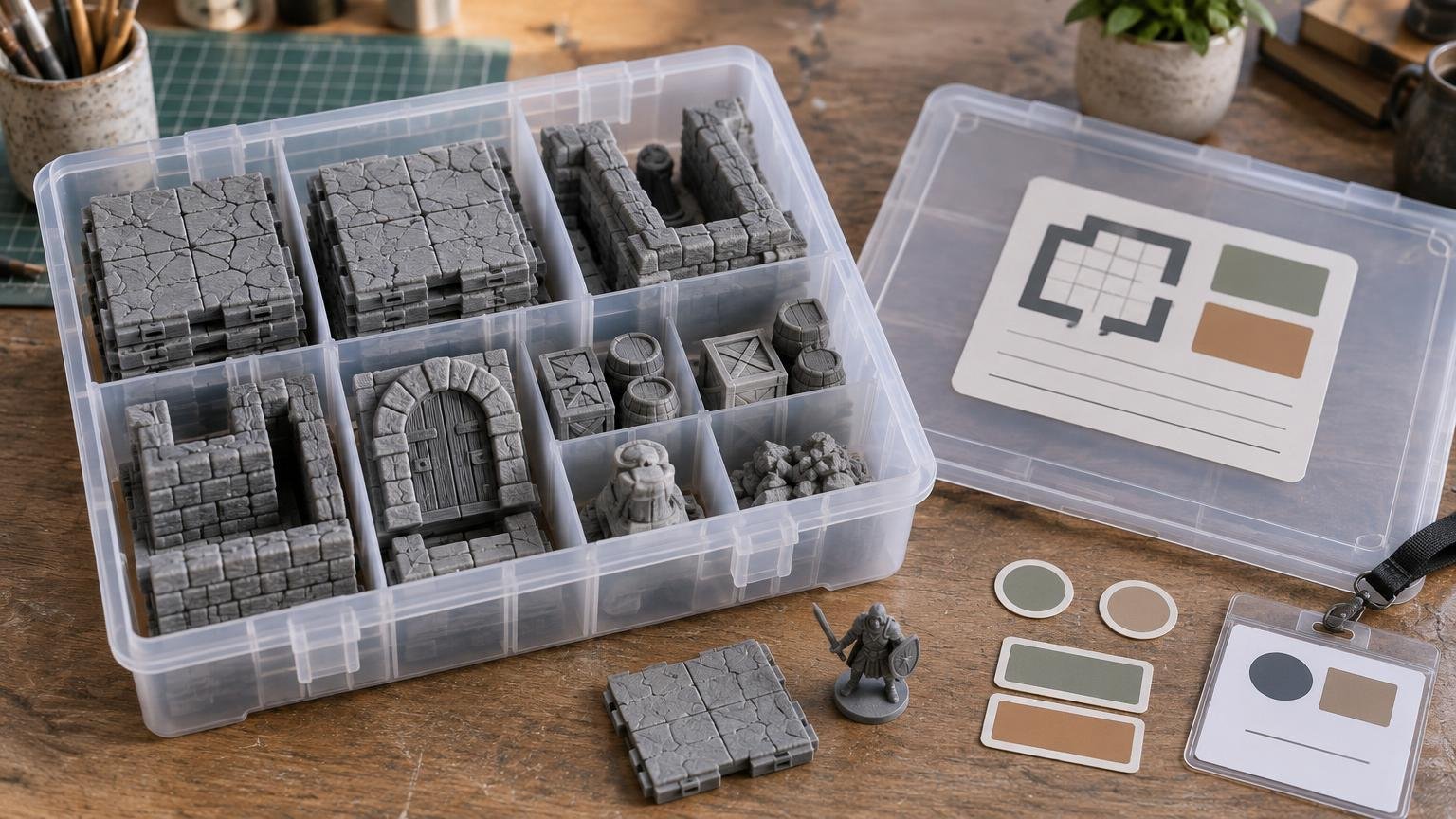
Clear bin sides have more room, so they can carry a collection name, contents, and box ID. Test the design against both an empty bin and its likely contents. A clear label with dark lettering may look excellent on an empty transparent box but become unreadable when dark dungeon pieces sit behind it.
Foam trays and fabric cases require caution. Our test does not establish adhesion, residue, or removability on foam, textured fabric, powder-coated metal, cardboard, or every molded storage plastic. Place a small sample on an inconspicuous area and leave it through normal handling before committing an entire case. Where the surface is unsuitable, label a rigid tag or insert rather than the case itself.
Large terrain tubs need larger type that can be read from shelf distance. Prioritize the terrain family and box number. Detailed contents can live on an inventory card inside the lid or in a separate spreadsheet; forcing the complete inventory onto the exterior usually produces a crowded label that is harder to use.
Matte, gloss, and clear labels have different jobs
Matte is a practical default for storage shelves and convention rooms where overhead lights can create glare. Gloss can give colors and artwork more visual punch, making it useful for club emblems, event kits, or front-facing cases. CustomStickers.com offers both matte and gloss finishes. Our physical testing supports the quality score assigned to the sticker samples we received, not a universal conclusion about every finish in every label format.
Clear labels work best when the container provides a predictable, contrasting background. If the contents regularly change the apparent background color, an opaque white or colored label is usually easier to read. Readability should win over the appeal of making the label edge less visible.
For roll labels, the company states that it uses BOPP with or without lamination. It describes laminated BOPP labels as waterproof and more resistant to water and oil, and generally suitable for up to two years. These are manufacturer-stated specifications, not lifespan results independently established on miniature-storage containers.
Prepare and proof the artwork carefully
CustomStickers.com recommends 300 ppi artwork for best results and offers online proofs with unlimited revisions. Resolution still cannot compensate for text that is too small, weak color contrast, or a design packed too close to the cut line.
Before approving the proof, inspect each of these points:
- Confirm the finished dimensions against the actual flat area on the container.
- Read the proof at approximately its intended physical size, not only while zoomed in.
- Check spelling, abbreviations, box IDs, quantities, and scale notation.
- Inspect the cut line and ensure essential text or icons are not crowded against it.
- Verify that repeated designs have consistent colors, type sizes, and code structure.
- Confirm the number of unique designs and the quantity required for each.
- Review the current proof deadline instead of assuming the order will wait indefinitely.
The company’s FAQ says the first two custom-sticker designs are free and additional designs cost $3 each, while its proof policy says a proof may be approved automatically after three days. Policies can change, so confirm both details on the current order page. This matters for miniature storage because a project may contain many category designs even when its total sticker count is modest.
Order enough without creating unnecessary waste
Count containers, not miniatures. Then group duplicate designs and add a modest buffer for future drawers, replacements, and mistakes during application. Avoid ordering a large surplus around a naming system you have not yet used. A small pilot order can expose confusing abbreviations or colors before they spread across the entire hobby room.
Account for production time separately from shipping. CustomStickers.com’s label information lists a standard turnaround of five to eight business days and says label orders include two additional processing days. Its general shipping policy also notes that labels and large or bulk orders may take longer than the usual processing window. For a convention, work backward from the setup date and leave room for proof revisions, production, transit, and application.
Custom products generally are not eligible for change-of-mind returns. The company says it will reprint or reship qualifying orders affected by its printing, cutting, packing, shipping, sizing, or delivery errors, subject to its policy. That makes careful measurement and proof approval important: ordering the wrong size is different from receiving something that does not match an approved order.
What our recommendation does not claim
Our 4.7/5 score applies to the physically evaluated sticker products and ordering experience. We did not physically test every label roll or sheet, every listed finish, residue-free removal, adhesion to every storage material, or multi-year durability under repeated transport. Manufacturer claims about waterproofing, lamination, or product lifespan should remain separate from those observed results.
For removable or frequently relabeled inventory, test the surface and workflow first. A permanent-looking printed label may be the wrong tool if drawer contents change after every campaign. In that situation, put the stable category on the printed sticker and reserve changing details for an insert card, erasable tag, or digital inventory.
Frequently asked questions
Are custom stickers worth it for a small miniature collection?
They can be when you have a stable category system and want clearer, more consistent storage. For only a few changing boxes, printable inserts or removable tags may be more flexible. Custom stickers become more useful as the number of visually similar drawers, cases, and terrain tubs grows.
When do roll labels make sense?
Use rolls when one or a few designs repeat at high volume and fast application matters. Because CustomStickers.com states a 250-label minimum, rolls are more plausible for clubs, recurring convention kits, or extensive standardized inventories than for a one-off set of household drawers.
Should miniature-storage labels be matte or gloss?
Start with matte when shelf glare and quick reading are the priorities. Choose gloss when saturated color or artwork is more important and reflections will not interfere. Order decisions should follow the lighting and viewing angle of the actual storage area.
What should every terrain-box label include?
Include the terrain family, a clear contents category, and a unique box ID. Add scale only when it prevents confusion. Keep detailed piece counts elsewhere if including them would make the main label difficult to read or quickly outdated.
The practical recommendation
For small-to-medium projects with multiple categories, I recommend the tested custom vinyl sticker format. The 5/5 quality, price, and customer-service scores support that conclusion, while the 4.5/5 turnaround and 4/5 options score keep the recommendation grounded rather than perfect.
Inventory your containers, create a short naming system, test label readability at actual size, and choose the format by repeated quantity. If that process points to professionally printed stickers or labels, review the current formats, configurator pricing, proof terms, and production timing at CustomStickers.com. The best label is not the one with the most artwork; it is the one that gets the right miniatures or terrain onto the table with less searching.